


SDG Essay Competition Winner 2024-25
Adam Smith Business School postgraduate taught student wins first prize in the prestigious PRME UK and Ireland Responsible Business and Management student writing competition.
Necessary cookies enable core functionality. The website cannot function properly without these cookies, and can only be disabled by changing your browser preferences.
Analytical cookies help us improve our website. We use Google Analytics. All data is anonymised.
Clarity helps us to understand our users’ behaviour by visually representing their clicks, taps and scrolling. All data is anonymised.
Building on the legacy of Adam Smith, our values of being enlightened, engaged and entrepreneurial drive our commitment to the UN’s Sustainable Development Goals (SGDs).
We invest in Sustainable Innovation to contribute to solutions for a more sustainable, inclusive and equitable future. We promote Research and Expertise that contributes to cutting-edge thinking on responsible and sustainable management and Celebrate Community through our service and external engagement. We practice Responsible Governance to ensure accountability and transparency in decision-making and deploy a Strategic Use of Resources to reach sustainable future.
Key awards and rankings
In 2020 the Business School became a communicating signatory of the United Nations Principles of Responsible Management Education (PRME) and reports yearly on the Seven Principles: Purpose, Values, Teach, Research, Partner, Practice and Share.
By joining PRME, the School has made a powerful commitment to advancing values, such as sustainability, responsibility and ethics in teaching, research and thought leadership. We join over 700 leading business and management schools from more than 90 countries, dedicated to advancing these core values, while working to achieve the United Nations Sustainable Development Goals.
Since 2020, the Adam Smith Business School has sponsored Barefoot in Business. Undergraduate students from the School have worked with primary schoolgirls aged 11-12 in two Glasgow primary schools from disadvantaged areas on a pupil led workshop to design a brand and marketing strategy and awareness generating campaign. Our student volunteers attend the primary schools to deliver the workshop materials over an 8-week period before their business idea is brought to life on the university campus in the form of a pop-up shop where they sell the Ugandan made tote bags based on their own pricing and business strategy. Barefoot in Business plan to collaborate with Enactus, a student society to host future bake sales alongside the pupil’s popup shops.
All profits from the bags sold are divided equally between the schools and Ugandan Tailors and reinvested to partly fund the initiative in the next school year.
Twenty-two students in total from the School and over 120 students from the primary schools have participated in the programme since starting in 2020. The school now sponsors the primary schools to take part, and they keep the money from the sales to put back into the classroom and use towards a sustainability project.
Since 2022, a group of students from the MSc Environment and Sustainable Development programme have taken part in a beach clean-up at Seafield Beach, Kirkcaldy, in September as part of their induction programme. This is part of a UK wide initiative by the Marine Conservation Society. Combined with the clean-up, students learn more about the life of Adam Smith as they tour around his hometown. Some statistics from the Great British Beach Clean-up 2024:

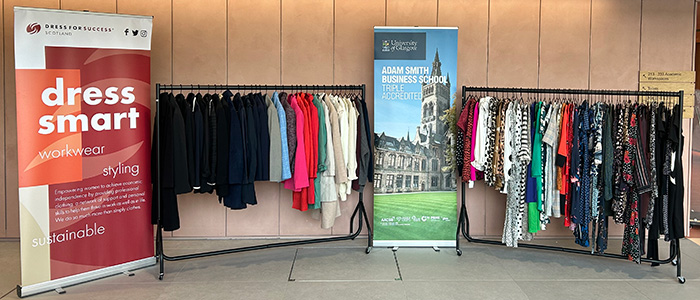
Inspired by International Women’s Day in March 2024, the Responsible Sustainable Management Committee set out help empower local women. They partnered with two Glasgow women’s charities, Dress for Success and Smartworks, who both have similar ambitions to help women get back into work and achieve financial independence, starting with their initial interview outfit. The team successfully held their first clothing drive in September 2024 where 1170L of women’s workwear was donated and evenly distributed between the two charities.
Following our donations, Smartworks said: September, we had our busiest month on record which included over 200 appointments, this includes:
A podcast where sustainability meets business, economics, and the environment. Hosted by students, grounded in real-world insights, and inspired by the belief that the next generation can and must work across disciplines to shape a better world.
We ask a vital question: What lessons can the Global South offer the Global North in addressing the climate emergency? To unpack these lessons, Ritwij speaks with Mr Erik Solheim, former Executive Director of the United Nations Environment Programme (UNEP) and former Environment Minister of Norway, who shares his insights.
We explore how finance can be a powerful force for climate action, especially in the Global South, where development and sustainability must go hand in hand. Ritwij speaks with special guest, Subhash Chandra Garg, former Finance Secretary of India and Executive Director at the World Bank, to discuss how countries can mobilise funds for a greener future.
We explore what happens when two students from completely different disciplines — economics and geosciences — begin a conversation they’ve never been taught to have. Laavanya sits down with Blythe Kaddour, a fourth-year Geosciences student and sustainability consultant, to unpack how misunderstandings between environmental science and business thinking shape the way we approach climate challenges.
The Honourable Isabella Lövin, former Deputy Prime Minister of Sweden, reflects on The Oceanic Feeling and the urgent need for a new narrative in global environmental governance, sustainability, and political leadership. Drawing on her experience, Lövin discusses how reimagining humanity’s relationship with nature is essential to addressing the planetary crises of our time.
Co-created by Responsible Sustainable Management (RMS) student reps and Enactus Glasgow, a special edition of the Eco-nomics Unscripted podcast was launched to celebrate Adam Smith Business School Sustainability Week. Bitesize episodes are now available where we sit down with a wide array of guests to discuss sustainability and business in a relatable, simple and fun way.
Cecilia and Matt Offord CMBE discuss the radical “ecological” business school concept. Hear about truly responsible leadership practices that transcend “tick-box” sustainability solutions and deliver sustainable positive impact for people and planet, and common myths surrounding business and sustainability.
We ask Robert McMaster about the “unquestioned questions” of sustainability and discuss why ethics should be central to economics and business, challenge assumptions like unlimited wants and endless growth, and explore why students must question what they are taught about sustainability and responsibility.
We unpack the often-overlooked topic of waste and why our consumption habits matter. We discuss the concept of anti-consumption, challenge myths around minimalism and economic growth, and explore how businesses and consumers can rethink value through reuse, circular systems, and more mindful consumption choices.
We explore the alternate economic perspectives of anarchy to link the concepts of human freedom to ecological freedom. We also explore the concept of mutual aid, challenge myths around top-down hierarchical solutions, and put forth grassroots community-led solutions and individual actions that can redefine our collective strength in tackling the climate crisis.
We discuss ways in which sustainability can be integrated into our everyday academic and lifestyle choices. We examine the role of volunteering and case competitions in reaching people beyond the green bubble, challenge myths around top-down solutions, and leave the listeners with an inspiring provocation and call to action as a takeaway.