

Digital Humanities MSc
Panel Discussion and Q&A About This Degree
Watch a recording of our recent panel discussion and Q&A with staff from this degree.
Our Master’s in Digital Humanities prepares you to engage with, and help shape, the future of digital research, creativity, curation, and analysis, through a combination of theory and practice. You'll explore innovative, collaborative, and socially impactful ways to study and present human culture in the digital age.
- Academic contact: Dr Kate Simpson
- Teaching start: September
- Glasgow: Gilmorehill campus
- MSc: 12 months full-time; 24 months part‑time
Why this programme
 Digital Humanities Presentation
- Investigate the intersection of technology, arts and humanities, and join a new generation of thinkers shaping how technology transforms creativity, culture and ideas.
- Combine theory and practice to develop expertise in the technical, creative, and ethical dimensions of digital humanities, and prepare for a role in creative and technology-driven industries, academia, or cultural heritage institutions.
- Through hands-on experience with the core technical and analytical methods of Digital Humanities, you’ll gain practical skills in managing digital archives, applying metadata standards, and working with cultural data.
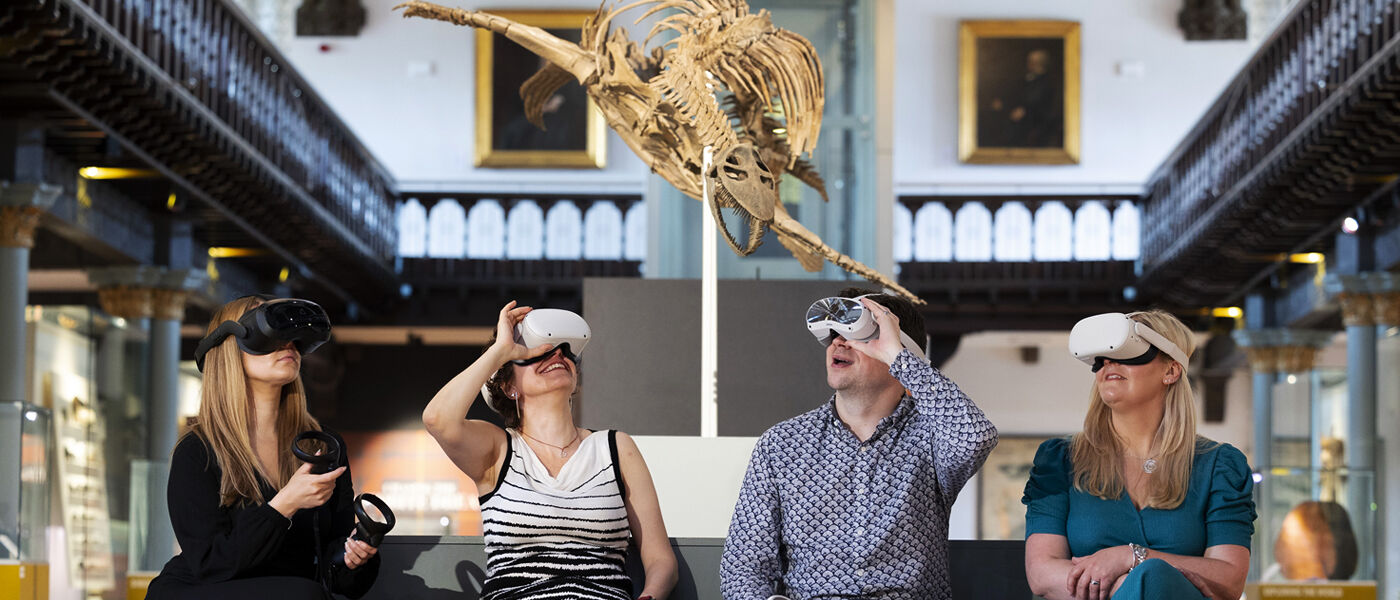
- Explore how digital platforms and technologies such as AI, Immersive Environments (VR, AR, XR) and digital storytelling can help art, culture, and academic research reach wider audiences.
- Collaborate in a diverse, international learning community that brings together technology, the arts, and the humanities. The University of Glasgow is a member of the global iSchools consortium, a network of over 130 universities with a shared focus on information, digital scholarship, and interdisciplinary research. The programme also benefits from a formal collaboration with the National Library of Scotland, giving you opportunities to engage with one of the country’s other leading cultural and research institutions.
- Benefit from studying in a multidisciplinary environment in one of the world's top 70 universities for Arts & Humanities (QS World University Rankings by Subject).
Programme structure
Gain expertise in the key areas of digital humanities through our core courses, with the flexibility to tailor the programme to your interests and career goals through a choice of optional courses.
Semester 1
Core courses
Optional course
You will take one optional course. Typical choices include:
- Special Collections and Digital Scholarship
- AI for the Arts and Humanities (A)
- Multimedia Analysis & Design (A)
- Music Curation and Analytics
Semester 2
Core course
Optional courses
You will take two optional courses. Typical choices include:
- Multimedia Analysis and Design B
- Data Analysis, Visualisation and Communication
- Digital Imaging
- Digital Engagement and Immersive Environments
- Document Encoding
Optional courses
You will have the opportunity to choose from a wide range of courses, allowing you to tailor the programme to suit your own interests and career goals. As well as the typical choices taken by students on this programme, you may also choose from options such as the following:
- Law, Information Governance and Collections
- Learning and Engagement in Cultural Heritage
- Portfolio of Professional Practice
- Decolonising the Heritage of Slavery and Colonialism
Other courses within the College of Arts and Humanities may also be available, subject to approval. See:
Note: not all courses may be available every year.
Summer
Apply the practical skills and the theoretical understanding you've gained in a real-world project with your applied dissertation.
Programme alteration or discontinuation
The University of Glasgow endeavours
to run all programmes as advertised. In exceptional circumstances, however, the University may withdraw
or alter a programme. For more information, please see: Student contract.
Career prospects
Graduates of the MSc in Digital Humanities are well prepared for diverse and evolving career paths at the intersection of technology, culture, and research.
The programme equips students with the technical, analytical, and creative skills needed for roles in academia, digital scholarship, cultural heritage and museums, archives, publishing, and the wider creative and technology sectors.
Graduates may go on to work as digital researchers, data curators, cultural technologists, or project managers in digitally focused cultural and research organisations, or pursue further academic study in the rapidly growing field of digital humanities.
Fees & funding
Tuition fees for 2026-27
MSc
Home & RUK
- Full-time fee: £11,367
- Part-time fee: £1,263 per 20 credits
International & EU
- Full-time fee: £26,460
Fee status
Additional fees
- Fee for re-assessment of a dissertation (PGT programme): £370
- Submission of thesis after deadline lapsed: £350
- Registration/exam only fee: £170
Entry requirements
2.1 Hons (or non-UK equivalent) in any subject.
A 2.2 Honours degree may be considered.
Substantial, directly relevant experience may be considered in place of formal qualifications. If you are applying based on relevant experience, please include a personal statement evidencing this with your application.
English language requirements
For applicants from non-English speaking countries, as defined by the UK Government, the University sets a minimum English Language proficiency level.
International English Language Testing System (IELTS) Academic and Academic Online (not General Training)
- 6.5 overall with no subtest less than 6.0
- IELTS One Skill Retake Accepted
- Tests must have been taken within 2 years 5 months of programme start date. Applicants must meet the overall and subtest requirements using a single test.
Common equivalent English language qualifications accepted for entry to this programme:
TOEFL (ibt, mybest or athome)
Tests taken up to 20 January 2026
- 90 Overall, no subtest lower than Reading 20; Listening 19; Speaking 19; Writing 21
- Tests must have been taken within 2 years 5 months of programme start date. Applicants must meet the overall and subtest requirements using a single test, this includes TOEFL mybest.
Tests taken from 21 January 2026
- 92 Overall, no subtest lower than Reading 22; Listening 20; Speaking 23; Writing 21
- Tests must have been taken within 2 years 5 months of programme start date. Applicants must meet the overall and subtest requirements using a single test, this includes TOEFL mybest.
Pearsons PTE Academic
- 65 overall with no subtest less than Reading 60; Listening 60; Speaking 65; Writing 60
- Online PTE not accepted for entry
- Tests must have been taken within 2 years 5 months of programme start date. Applicants must meet the overall and subtest requirements using a single test.
Cambridge Proficiency in English (CPE) and Cambridge Advanced English (CAE)
- 176 overall with no subtest less than 169
- Tests must have been taken within 2 years 5 months of programme start date. Applicants must meet the overall and subtest requirements using a single test.
Oxford English Test
- 7 overall with no subtest less than 6
- Tests must have been taken within 2 years 5 months of programme start date. Applicants must meet the overall and subtest requirements using a single test.
LanguageCert Academic/ Academic Online
- 70 overall with no subtest less than 65
- Tests must have been taken within 2 years 5 months of programme start date. Applicants must meet the overall and subtest requirements using a single test.
Password Skills Plus
- 6.5 overall with no subtest less than 6.0
- Tests must have been taken within 2 years 5 months of programme start date. Applicants must meet the overall and subtest requirements using a single test.
Trinity College Integrated Skills in English II
- Two subtests at 96 or higher, and two subtests at 80 or higher
- Tests must have been taken within 2 years 5 months of programme start date. Applicants must meet the overall and subtest requirements using a single test.
Kaplan Test of English
- Any two subtests at 480 or higher, and any two subtests at 450 or higher
- Tests must have been taken within 2 years 5 months of programme start date. Applicants must meet the overall and subtest requirements using a single test.
University of Glasgow Pre-sessional courses
Tests are accepted for 2 years following date of successful completion.
Alternatives to English Language qualification
- Degree from majority-English speaking country (as defined by the UKVI including Canada if taught in English)
- students must have studied for a minimum of their final year at Undergraduate level, or 9 months at Master's level, and must have completed their degree in that majority-English speaking country within the last 6 years.
- Undergraduate 2+2 and 3+1 degrees from majority-English speaking country (as defined by the UKVI including Canada if taught in English)
- students must have completed their final year of study in that majority-English speaking country within the last 6 years.
For international students, the Home Office has confirmed that the University can choose to use these tests to make its own assessment of English language ability for visa applications to degree level programmes. The University is also able to accept UKVI approved Secure English Language Tests (SELT) but we do not require a specific UKVI SELT for degree level programmes. We therefore still accept any of the English tests listed for admission to this programme.
Pre-sessional courses
The University of Glasgow accepts evidence of the required language level from the English for Academic Study Unit Pre-sessional courses. We would strongly encourage you to consider the pre-sessional courses at the University of Glasgow's English for Academic Study (EAS) Unit. Our Pre-sessional courses are the best way to bring your English up to entry level for University study. Our courses give you:
- direct entry to your University programme for successful students (no need to take IELTS);
- essential academic skills to help you study effectively at University;
- flexible entry dates so you can join the right course for your level.
More information on our Pre-sessional courses.
We can also consider the pre-sessional courses accredited by the below BALEAP approved institutions to meet the language requirements for admission to our postgraduate taught degrees:
- Heriot Watt
- Kingston Upon Thames
- Middlesex University
- Manchester University
- Reading University
- Edinburgh University
- ST Andrews University
- UCL
- Durham
For further information about English language requirements, please contact the Recruitment and International Office using our enquiry form
For applicants from non-majority English speaking countries, as defined by the UK Government, the University sets a minimum English Language proficiency level.
Accepted English Language Tests
We accept a wide range of English language tests for entry to this programme. Tests must have been taken within 2 years 5 months of programme start date, and requirements must be met using a single test.
IELTS Academic/IELTS Academic for UKVI/ IELTS Academic online
- 6.5 overall with no subtest less than 6.0
- IELTS One Skill Retake Accepted
- We do not accept General Training
TOEFL iBT (including MyBest and Home Edition)
Test taken up to 20 January 2026
- 90 overall with no subtest less than Reading 20; Listening 19; Speaking 19; Writing 21
Tests taken from 21 January 2026
- 92 overall with no subtest less than 4.5
PTE Academic (test centre only)
- 65 overall with no subtest less than Reading 60; Listening 60; Speaking 65; Writing 60
- We do not accept the online PTE Academic
Cambridge C1 Advanced and C2 Proficiency
- 176 overall with no subtest less than 169
Oxford ELLT
- 7 overall with no subtest less than 6
LanguageCert Academic/Academic SELT/ Academic Online
- 70 overall with no subtest less than 65
Password Skills Plus
- 6.5 overall with no subtest less than 6.0
Trinity College Integrated Skills in English II
- 96 overall with no subtest less than 90
Kaplan Test of English
- Any two subtests at 480 or higher, and any two subtests at 450 or higher
PSI Skills for English
- B2 Pass with Merit
Duolingo English Test
- 120 overall with writing at 120 and no subtest less than 110
Oxford Test of English Advanced
- 140 Overall with any two subtests at 126 or higher, and any two subtests at 136 or higher
Alternatives to English Language test
Degree from majority-English speaking country (as defined by the UKVI including Canada if taught in English)
- students must have studied for a minimum of their final year at Undergraduate level, or 9 months at Master's level, and must have completed their degree in that majority-English speaking country within 6 years of programme start.
TNE degree from UK university taught at a campus outside of the UK
- students must be awarded the degree by the UK university and must have completed the degree within 6 years of programme start.
Pre-sessional courses
The University of Glasgow accepts evidence of the required language level from the English for Academic Study Unit Pre-sessional courses. We would strongly encourage you to consider the pre-sessional courses at the University of Glasgow's English for Academic Study (EAS) Unit. Our Pre-sessional courses are the best way to bring your English up to entry level for University study and remain valid for 2 years following date of successful completion.
Our courses give you:
- direct entry to your University programme for successful students (no need to take IELTS);
- essential academic skills to help you study effectively at University;
- flexible entry dates so you can join the right course for your level.
For more detail on our pre-sessional courses please see: https://www.gla.ac.uk/schools/mlc/eas/pre-sessionalcourses/
We can also consider the pre-sessional courses accredited by the below BALEAP approved institutions to meet the language requirements for admission to our postgraduate taught degrees:
- Heriot Watt
- Kingston Upon Thames
- Middlesex University
- Manchester University
- Reading University
- Edinburgh University
- St Andrews University
- UCL
- Durham
International students
We are proud of our diverse University community that includes students and staff from more than 140 different countries.
How to apply
To apply for a postgraduate taught degree you must apply online. We cannot accept applications any other way.
Please check you meet the Entry requirements for this programme before you begin your application.
Documents
As part of your online application, you also need to submit the following supporting documents:
- A copy (or copies) of your official degree certificate(s) (if you have already completed your degree)
- A copy (or copies) of your official academic transcript(s), showing full details of subjects studied and grades/marks obtained
- Official English translations of the certificate(s) and transcript(s)
- Evidence of your English language ability (if your first language is not English)
- Any additional documents required for this programme (see Entry requirements for this programme)
- A copy of the photo page of your passport
We may also request additional documents such as a personal statement, portfolio, references or a sample of academic writing to support your application.
If we request a reference, this should typically be an academic reference. However, where this is not possible, a reference from a current employer may be accepted. If you already have a copy of your reference on letterheaded paper, you can upload this with your application. Otherwise, you may provide your referee’s name and contact details on the online application, and we will contact them directly.
You have 42 days to submit your application once you begin the process.
You may save and return to your application as many times as you wish to update information, complete sections or upload supporting documents such as your final transcript or your language test.
For more information about submitting documents or other topics related to applying to a postgraduate taught programme, see how to apply for a postgraduate taught degree
Guidance notes for using the online application
These notes are intended to help you complete the online application form accurately; they are also available within the help section of the online application form.
If you experience any difficulties accessing the online application, see Application System Help.
- Name and Date of birth: must appear exactly as they do on your passport. Please take time to check the spelling and lay-out.
- Contact Details: Correspondence address. All contact relevant to your application will be sent to this address including the offer letter(s). If your address changes, please contact us as soon as possible.
- Choice of course: Please select carefully the course you want to study. As your application will be sent to the admissions committee for each course you select it is important to consider at this stage why you are interested in the course and that it is reflected in your application.
- Proposed date of entry: Please state your preferred start date including the month and the year. Taught masters degrees tend to begin in September. Research degrees may start in any month.
- Education and Qualifications: Please complete this section as fully as possible indicating any relevant Higher Education qualifications starting with the most recent. Complete the name of the Institution (s) as it appears on the degree certificate or transcript.
- English Language Proficiency: Please state the date of any English language test taken (or to be taken) and the award date (or expected award date if known).
- Employment and Experience: Please complete this section as fully as possible with all employments relevant to your course. Additional details may be attached in your personal statement/proposal where appropriate.
Application deadlines
Application deadlines for 2027 entry will be published in due course. Please check back later.
Apply now
Postgraduate events
