

Applied Linguistics MSc

Panel Discussion and Q&A About This Degree
Watch a recording of our recent panel discussion and Q&A with students and staff from this degree.
This Masters focuses on how linguistic research can help solve language-related problems in professional practice and public life. It is designed for you to become a research-led specialist in areas such as language and education, intercultural communication, language and politics and professional discourse. You will have an opportunity to design and undertake your own applied research project as part of this degree.
- Academic contact: Professor Tom Bartlett
- Teaching start: September
- Glasgow: Gilmorehill campus
- MSc: 12 months full-time; 24 months part‑time
Why this programme
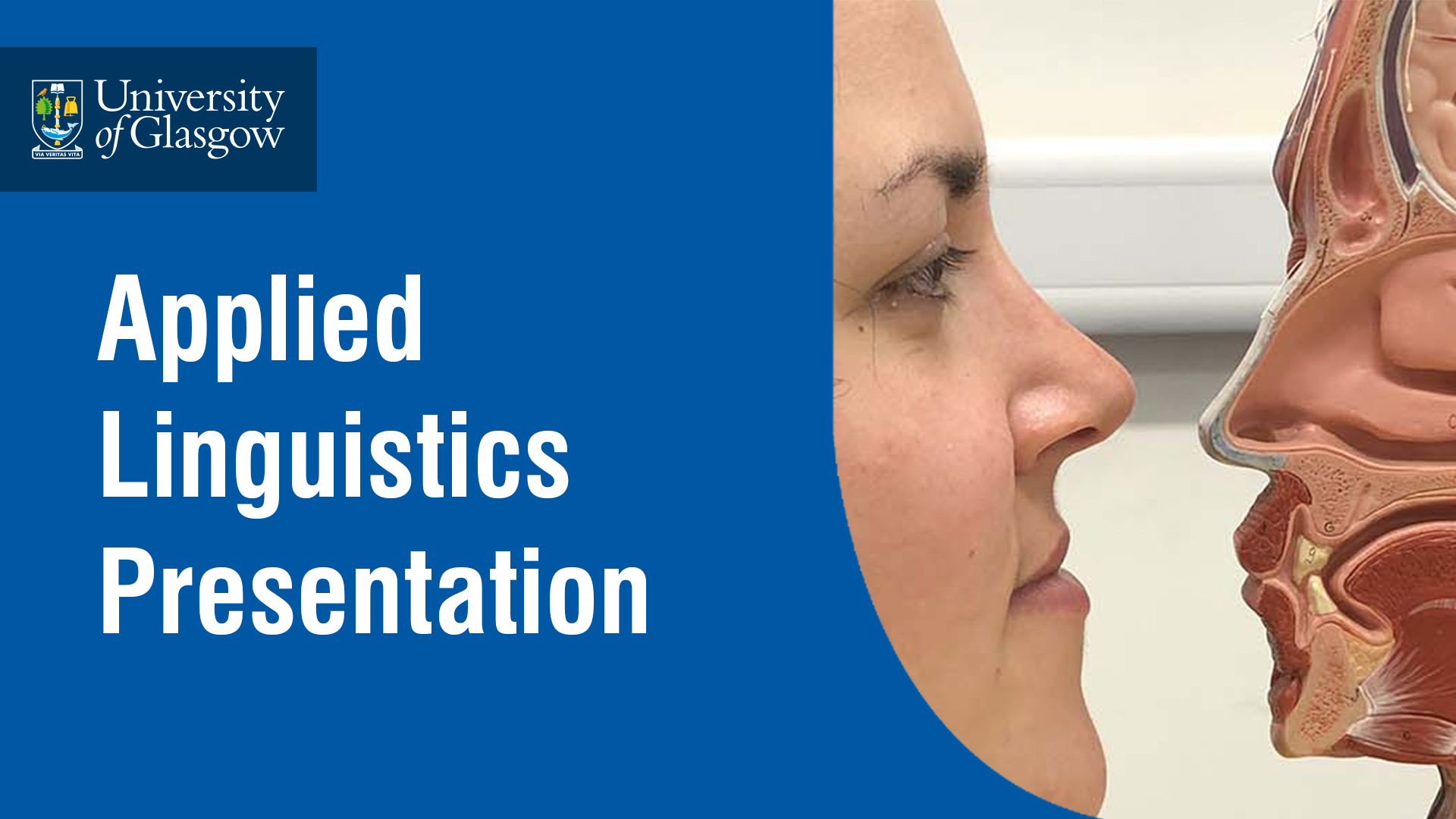 https://www.youtube.com/watch?v=dFfaDt-c-aU
- This programme allows you to supplement specialist courses in Applied Linguistics with a wide range of topics of your choosing, including discourse analysis, name studies, psycholinguistics, sociolinguistics, phonetics and more.
- We cover diverse areas of linguistics, from understanding accent bias and improving language education to exploring language learning, teaching, and forensic linguistics.
- You'll examine the practical applications of linguistics, from supporting the work of government bodies and police services to addressing global challenges through topics such as language, sustainability and environmentalism.
- Our facilities include an outstanding provision of linguistic laboratories, including digital humanities, corpus resources and phonetics.
What our students say
This programme has really helped me see multilingual speakers in a much more empowering way. Something special that we have on our programme is the research seminars... I'm able to approach a lot of different fields in linguistics that I may not have had a chance to otherwise. We were able to meet and interact with the researchers afterwards and ask them questions... that was very inspiring for me. Our professors, our lecturers, they're very supportive. The environment here was very friendly. You could have your community here, really build a community here. Linh, MSc student
Programme structure
Teaching is delivered full-time across two semesters, followed by your own in-depth research-led dissertation in Applied Linguistics. You will undertake two core courses, and four optional courses in areas such as Systemic Functional Linguistics, Language Learning and Teaching, and Forensic Linguistics.
Alongside optional courses in Applied Linguistics, the programme also offers a range of optional courses from linguistics, English, and other disciplines, enabling you to create your own Masters programme. The programme allows you to work in an interdisciplinary capacity, selecting courses from across the College of Arts & Humanites, according to personal interests. The programme convenor will work with you to construct a suitable portfolio of courses according to your personal aims and objectives.
Semester one
In semester one, you will take one core course and two optional courses.
Core course
Semester two
In semester two, you will take two core courses and two optional courses.
Core course
- Research Training Course 2: Dissertation Preparation
- Applying Linguistics in Social and Professional Life
Dissertation
Optional courses
Students will take four optional courses over the two semesters.
We would advise students with an interest in educational applications to choose at least two courses from the following selection:
- Language and the Global Campus: Linguistic Issues in the Internationalisation of Higher Education
- Social and Individual Variables in Language Learning and Teaching
- Systemic Functional Linguistics and its Applications
We would advise students with an interest in social applications to choose the following two courses:
Remaining options can be taken from the courses listed above or from among the 20-credit courses listed under the ELL and TESOL pathways, subject to availability and capacity.
Optional courses that would be particularly relevant to the Applied Linguistics programme include:
- Corpus Linguistics (PGT)
- Experimental Design and Data Analysis
- Qualitative Methods in Sociolinguistics
- Approaches to Scots in Speech and Text
With the convenor’s permission, you may also take optional courses from elsewhere in the College of Arts & Humanities and beyond.
In addition, you will have the opportunity to take a bespoke 10-credit course (Advancing English for Applied Linguistics) which will help you develop your academic writing skills relevant for the discipline. This is an optional course which you can take in addition to the courses we offer as part of the programme.
Programme alteration or discontinuation
The University of Glasgow endeavours
to run all programmes as advertised. In exceptional circumstances, however, the University may withdraw
or alter a programme. For more information, please see: Student contract.
Career prospects
Our graduates in Applied Linguistics have a wide range of career options available to them in careers where language and communication skills are valued and developed. The degree is especially suitable for those wishing to develop their careers in teaching, communications or administration, and to enhance their prospects at home and internationally.
Some of our graduates have also found the programme useful as a foundation for further study at doctoral level, such as a PhD in Applied Linguistics or Linguistics more generally.
Regardless of your next steps, the range of skills developed during this degree programme will be of use in many professional contexts.
Fees & funding
Tuition fees for 2026-27
MSc
Home & RUK
- Full-time fee: £11,367
- Part-time fee: £1,263 per 20 credits
International & EU
- Full-time fee: £27,720
Fee status
Deposits
International and EU applicants are required to pay a deposit of £2,000 when an offer is made.
Deposits: terms & conditions
The following guidelines will apply in determining whether a deposit will be refunded. Where the deposit is refunded, a 25% administration fee will be deducted unless otherwise stated.
a: Deposits WILL be refunded to applicants under the following circumstances:
- Where the University is unable to offer you a place on the programme as specified on the offer. A full refund will be issued in this case.
- Death of a close family member (parent/guardian, grandparent, sibling, spouse, child/dependent). Official evidence (signed and stamped) must be provided.
- SERIOUS ill health of the applicant or a close family member (parent/guardian, grandparent, sibling, spouse, child/dependent). Official evidence (signed and stamped) must be provided.
- Applicant does not meet conditions of offer. This may be academic or language test requirements. Satisfactory evidence must be uploaded to the student’s applicant self-service to prove that they have not met the conditions of their offer (note that applicants who do not meet the language condition of their offer must show reasonable attempt to meet this, i.e. they must provide at least two language tests which were taken after the date the deposit was paid).
- Visa / ATAS refusal: we will only consider a refund if the visa / ATAS refusal was based on matters outside of the applicant’s control.
- If a refund request is received within 14 days of the deposit being received a full refund will be issued under the Consumer Protection Regulations.
b: Deposits WILL NOT be refunded to applicants under the following circumstances:
- An applicant decides not to attend the University for any reason not outlined above.
- Personal financial constraints / unsuccessful scholarship application.
- Applicant has decided to defer – in this situation the University will retain the deposit and hold it against the applicant’s account to secure their place for the following year of entry. You may defer twice. After the second deferral standard conditions will apply.
- There is still time to meet the English language test requirement before the final upload date. Please see section a) 4.
- Visa / ATAS was applied for too late. Please see section a) 5.
- Any documents used for admission are proven to be fraudulent. We work in partnership with Qualification Check to check academic qualifications. English language qualifications are verified with the provider.
- The refund request is received more than 30 days after the official course start date as outlined in your offer email.
Timeframe for requesting a refund
Refund requests must be received no later than 30 days after the official course start date as outlined in your offer email. As per section b)7 above the request will be denied.
Receiving a refund
- To comply with Money Laundering Regulations, the University will pay all refunds to the original payer using the source payment details. This is known as a “return to source” payment.
- All appropriate documentation and evidence relating to the original payment must be provided, when requested.
- All payments and refunds are in GBP currency - the University is not responsible for any exchange rate fluctuations or beneficiary bank charges associated with the refund.
- Where University approved payment methods have not been used, this may cause significant delays or prevent payment altogether.
- We will aim to issue the deposit refund within 8 weeks of receipt of information per point 2 above. At peak times this may be longer.
How to request a deposit refund
Please go to our enquiry form and select 'Fees and Deposit' as the enquiry reason and then 'Can I have a deposit refund?'.
Please upload all supporting documentation to your applicant self-service portal before submitting the above request.
Additional fees
- Fee for re-assessment of a dissertation (PGT programme): £370
- Submission of thesis after deadline lapsed: £350
- Registration/exam only fee: £170
Entry requirements
2.1 Hons (or non-UK equivalent) in any subject.
A 2.2 Honours degree may be considered.
Substantial, directly relevant experience may be considered in place of formal qualifications. If you are applying based on relevant experience, please include a personal statement evidencing this with your application.
English language requirements
For applicants from non-English speaking countries, as defined by the UK Government, the University sets a minimum English Language proficiency level.
International English Language Testing System (IELTS) Academic and Academic Online (not General Training)
- 6.5 overall with no subtest less than 6.0
- IELTS One Skill Retake Accepted
- Tests must have been taken within 2 years 5 months of programme start date. Applicants must meet the overall and subtest requirements using a single test.
Common equivalent English language qualifications accepted for entry to this programme:
TOEFL (ibt, mybest or athome)
Tests taken up to 20 January 2026
- 90 Overall, no subtest lower than Reading 20; Listening 19; Speaking 19; Writing 21
- Tests must have been taken within 2 years 5 months of programme start date. Applicants must meet the overall and subtest requirements using a single test, this includes TOEFL mybest.
Tests taken from 21 January 2026
- 92 Overall, no subtest lower than Reading 22; Listening 20; Speaking 23; Writing 21
- Tests must have been taken within 2 years 5 months of programme start date. Applicants must meet the overall and subtest requirements using a single test, this includes TOEFL mybest.
Pearsons PTE Academic
- 65 overall with no subtest less than Reading 60; Listening 60; Speaking 65; Writing 60
- Online PTE not accepted for entry
- Tests must have been taken within 2 years 5 months of programme start date. Applicants must meet the overall and subtest requirements using a single test.
Cambridge Proficiency in English (CPE) and Cambridge Advanced English (CAE)
- 176 overall with no subtest less than 169
- Tests must have been taken within 2 years 5 months of programme start date. Applicants must meet the overall and subtest requirements using a single test.
Oxford English Test
- 7 overall with no subtest less than 6
- Tests must have been taken within 2 years 5 months of programme start date. Applicants must meet the overall and subtest requirements using a single test.
LanguageCert Academic/ Academic Online
- 70 overall with no subtest less than 65
- Tests must have been taken within 2 years 5 months of programme start date. Applicants must meet the overall and subtest requirements using a single test.
Password Skills Plus
- 6.5 overall with no subtest less than 6.0
- Tests must have been taken within 2 years 5 months of programme start date. Applicants must meet the overall and subtest requirements using a single test.
Trinity College Integrated Skills in English II
- Two subtests at 96 or higher, and two subtests at 80 or higher
- Tests must have been taken within 2 years 5 months of programme start date. Applicants must meet the overall and subtest requirements using a single test.
Kaplan Test of English
- Any two subtests at 480 or higher, and any two subtests at 450 or higher
- Tests must have been taken within 2 years 5 months of programme start date. Applicants must meet the overall and subtest requirements using a single test.
University of Glasgow Pre-sessional courses
Tests are accepted for 2 years following date of successful completion.
Alternatives to English Language qualification
- Degree from majority-English speaking country (as defined by the UKVI including Canada if taught in English)
- students must have studied for a minimum of their final year at Undergraduate level, or 9 months at Master's level, and must have completed their degree in that majority-English speaking country within the last 6 years.
- Undergraduate 2+2 and 3+1 degrees from majority-English speaking country (as defined by the UKVI including Canada if taught in English)
- students must have completed their final year of study in that majority-English speaking country within the last 6 years.
For international students, the Home Office has confirmed that the University can choose to use these tests to make its own assessment of English language ability for visa applications to degree level programmes. The University is also able to accept UKVI approved Secure English Language Tests (SELT) but we do not require a specific UKVI SELT for degree level programmes. We therefore still accept any of the English tests listed for admission to this programme.
Pre-sessional courses
The University of Glasgow accepts evidence of the required language level from the English for Academic Study Unit Pre-sessional courses. We would strongly encourage you to consider the pre-sessional courses at the University of Glasgow's English for Academic Study (EAS) Unit. Our Pre-sessional courses are the best way to bring your English up to entry level for University study. Our courses give you:
- direct entry to your University programme for successful students (no need to take IELTS);
- essential academic skills to help you study effectively at University;
- flexible entry dates so you can join the right course for your level.
More information on our Pre-sessional courses.
We can also consider the pre-sessional courses accredited by the below BALEAP approved institutions to meet the language requirements for admission to our postgraduate taught degrees:
- Heriot Watt
- Kingston Upon Thames
- Middlesex University
- Manchester University
- Reading University
- Edinburgh University
- ST Andrews University
- UCL
- Durham
For further information about English language requirements, please contact the Recruitment and International Office using our enquiry form
For applicants from non-majority English speaking countries, as defined by the UK Government, the University sets a minimum English Language proficiency level.
Accepted English Language Tests
We accept a wide range of English language tests for entry to this programme. Tests must have been taken within 2 years 5 months of programme start date, and requirements must be met using a single test.
IELTS Academic/IELTS Academic for UKVI/ IELTS Academic online
- 6.5 overall with no subtest less than 6.0
- IELTS One Skill Retake Accepted
- We do not accept General Training
TOEFL iBT (including MyBest and Home Edition)
Test taken up to 20 January 2026
- 90 overall with no subtest less than Reading 20; Listening 19; Speaking 19; Writing 21
Tests taken from 21 January 2026
- 92 overall with no subtest less than 4.5
PTE Academic (test centre only)
- 65 overall with no subtest less than Reading 60; Listening 60; Speaking 65; Writing 60
- We do not accept the online PTE Academic
Cambridge C1 Advanced and C2 Proficiency
- 176 overall with no subtest less than 169
Oxford ELLT
- 7 overall with no subtest less than 6
LanguageCert Academic/Academic SELT/ Academic Online
- 70 overall with no subtest less than 65
Password Skills Plus
- 6.5 overall with no subtest less than 6.0
Trinity College Integrated Skills in English II
- 96 overall with no subtest less than 90
Kaplan Test of English
- Any two subtests at 480 or higher, and any two subtests at 450 or higher
PSI Skills for English
- B2 Pass with Merit
Duolingo English Test
- 120 overall with writing at 120 and no subtest less than 110
Oxford Test of English Advanced
- 140 Overall with any two subtests at 126 or higher, and any two subtests at 136 or higher
Alternatives to English Language test
Degree from majority-English speaking country (as defined by the UKVI including Canada if taught in English)
- students must have studied for a minimum of their final year at Undergraduate level, or 9 months at Master's level, and must have completed their degree in that majority-English speaking country within 6 years of programme start.
TNE degree from UK university taught at a campus outside of the UK
- students must be awarded the degree by the UK university and must have completed the degree within 6 years of programme start.
Pre-sessional courses
The University of Glasgow accepts evidence of the required language level from the English for Academic Study Unit Pre-sessional courses. We would strongly encourage you to consider the pre-sessional courses at the University of Glasgow's English for Academic Study (EAS) Unit. Our Pre-sessional courses are the best way to bring your English up to entry level for University study and remain valid for 2 years following date of successful completion.
Our courses give you:
- direct entry to your University programme for successful students (no need to take IELTS);
- essential academic skills to help you study effectively at University;
- flexible entry dates so you can join the right course for your level.
For more detail on our pre-sessional courses please see: https://www.gla.ac.uk/schools/mlc/eas/pre-sessionalcourses/
We can also consider the pre-sessional courses accredited by the below BALEAP approved institutions to meet the language requirements for admission to our postgraduate taught degrees:
- Heriot Watt
- Kingston Upon Thames
- Middlesex University
- Manchester University
- Reading University
- Edinburgh University
- St Andrews University
- UCL
- Durham
International students
We are proud of our diverse University community that includes students and staff from more than 140 different countries.
How to apply
To apply for a postgraduate taught degree you must apply online. We cannot accept applications any other way.
Please check you meet the Entry requirements for this programme before you begin your application.
Documents
As part of your online application, you also need to submit the following supporting documents:
- A copy (or copies) of your official degree certificate(s) (if you have already completed your degree)
- A copy (or copies) of your official academic transcript(s), showing full details of subjects studied and grades/marks obtained
- Official English translations of the certificate(s) and transcript(s)
- Evidence of your English language ability (if your first language is not English)
- Any additional documents required for this programme (see Entry requirements for this programme)
- A copy of the photo page of your passport
We may also request additional documents such as a personal statement, portfolio, references or a sample of academic writing to support your application.
If we request a reference, this should typically be an academic reference. However, where this is not possible, a reference from a current employer may be accepted. If you already have a copy of your reference on letterheaded paper, you can upload this with your application. Otherwise, you may provide your referee’s name and contact details on the online application, and we will contact them directly.
You have 42 days to submit your application once you begin the process.
You may save and return to your application as many times as you wish to update information, complete sections or upload supporting documents such as your final transcript or your language test.
For more information about submitting documents or other topics related to applying to a postgraduate taught programme, see how to apply for a postgraduate taught degree
Guidance notes for using the online application
These notes are intended to help you complete the online application form accurately; they are also available within the help section of the online application form.
If you experience any difficulties accessing the online application, see Application System Help.
- Name and Date of birth: must appear exactly as they do on your passport. Please take time to check the spelling and lay-out.
- Contact Details: Correspondence address. All contact relevant to your application will be sent to this address including the offer letter(s). If your address changes, please contact us as soon as possible.
- Choice of course: Please select carefully the course you want to study. As your application will be sent to the admissions committee for each course you select it is important to consider at this stage why you are interested in the course and that it is reflected in your application.
- Proposed date of entry: Please state your preferred start date including the month and the year. Taught masters degrees tend to begin in September. Research degrees may start in any month.
- Education and Qualifications: Please complete this section as fully as possible indicating any relevant Higher Education qualifications starting with the most recent. Complete the name of the Institution (s) as it appears on the degree certificate or transcript.
- English Language Proficiency: Please state the date of any English language test taken (or to be taken) and the award date (or expected award date if known).
- Employment and Experience: Please complete this section as fully as possible with all employments relevant to your course. Additional details may be attached in your personal statement/proposal where appropriate.
Application deadlines
Application deadlines for 2027 entry will be published in due course. Please check back later.
Apply nowRelated programmes

Postgraduate events
