

UofG Change Framework and Toolkit
As a world changing university, we are committed to continually improving and transforming how we approach research, teaching, impact and operations.
The UofG Change Framework and Toolkit is designed to support you in planning, reflecting on and delivering change. It brings together simple, practical tools to help you lead yourself and your teams through change with confidence and clarity.
Whether the change you are working on is large or small, the framework provides clear and collaborative approach to navigating key steps and considerations. This helps to ensure successful and sustainable outcomes aligned to our world changing ambitions.
Please note: if you anticipate that your proposed change may affect employment, contracts and/or terms of conditions of staff, please contact your local People & OD Business Partner for specialist advice or visit our Management of Organisational Change page.
UofG Change Framework
The UofG Change Framework is grounded in research, practical application, and experience, recognising that change is rarely linear. Rather than a single, fixed process, it breaks change into manageable phases that help structure thinking and action.
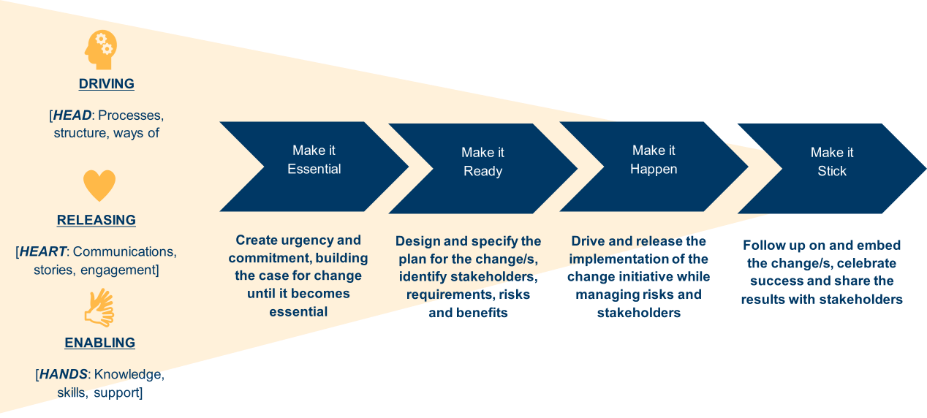
The framework identifies four core phases in any change journey:
- Phase 1: Make it Essential - This phase focuses on creating a sense of purpose and urgency by sharing the vision, creating interest, and beginning to build confidence in the change.
- Phase 2: Make it Ready - Here, the focus is on building momentum, understanding local change needs and developing the capability and readiness needed to deliver the change.
- Phase 3: Make it Happen - This phase is about putting the change into action, implementing plans, monitoring impact, and responding flexibly as learning emerges.
- Phase 4: Make it Stick - This final phase focuses on sustaining the change by embedding new ways of working, providing ongoing support and reflecting on lessons learned to inform future change.
While these phases provide structure, successful change is about more than applying tools or following guidelines. At its heart, change is about people and how they experience, understand and adopt what is changing.
That is why the framework highlights three critical forces that influence every phase. These forces run throughout the change journey and require continual attention, with emphasis adjusted to suit the needs of each phase.
The three forces of change:
- Driving [Head]: Focuses on clarity, structure and direction. This includes the rationale for change, governance, plans, processes, and decision-making, the technical foundations that underpins each phase.
- Releasing [Heart]: Focuses on engagement and motivation. This includes creating understanding, building commitment, addressing concerns, and enabling colleagues to feel involved and supported through change.
- Enabling [Hands]: Focuses on capability and delivery. This includes developing skills, knowledge, confidence and practical support needed to work in new ways and realise the benefits of change.
Using the Framework
How you apply the framework will vary depending on the type of change you are leading. Factors such as scale, complexity and context will influence which elements require greater focus and how deeply each phase needs to be explored.
For this reason, the UofG Change Framework should not be seen as a checklist or a linear process. Instead, it is a prompt and a guide, supporting you to navigate change thoughtfully, while being flexible and collaborative.
UofG Change Toolkit
Tools to support each phase of change
In this section, you’ll find a set of practical tools designed to support you in navigating change at each phase of the framework. You may not need every tool, but each one offers prompts and structure to help you focus on what matters most at different points in the change journey.

Phase 1: Make it essential
How you approach your change initiative in its early stages will directly influence both the effectiveness and impact of the change. Taking time to ask the right questions and gaining real clarity on why, how, who and what significantly increases the likelihood of success.
Phase 2: Make it ready
Preparing for change is a critical point in the change journey. This phase is about working collaboratively to clarify what the change will involve, what steps need to be taken and how best to manage the transition from current to future ways of working.

Phase 3: Make it happen
No matter how well you understand the anticipated impacts of change, this phase will almost always surface something unexpected. When this happens, it is an opportunity to pause, listen carefully, reflect on what is emerging and respond with clear direction and purposeful action.

Phase 4: Make it stick
This phase provides an opportunity to pause, reflect and celebrate success, while reinforcing commitment to the change and identifying opportunities to continuously improve our ways of working.
Develop your skills
Change is an opportunity to come together, discover new perspectives, learn and grow. Wherever you are on your change journey, we offer a range of development opportunities to help build confidence, capability and impact.
Develop your skills through formal development
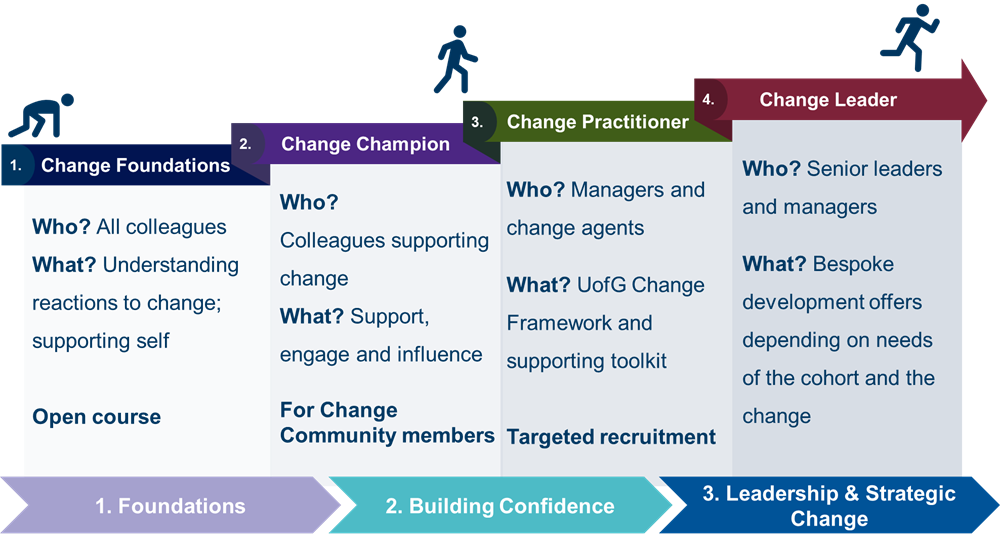
In partnership with People & OD Organisational Development Partners and the Transformation teams, we have curated a Change Development Pathway to support colleagues at different stages of their change practice.
Whether you are new to change, building confidence, or an experienced change practitioner looking to refresh and deepen your skills, there is an option for you.
Our Change Development Pathway includes four offerings:
- Change Foundations – bitsize course
- Change Champion
- Change Practitioner
- Change Leader
Interested in exploring the Change Development Pathway? Find out more and sign-up, visit here
Connect to colleagues to develop your practice
Learning from others is a powerful way to develop your change capability. Connecting with colleagues across the University allows you to share insights, build your network and grow confidence through real-world experience.
You may wish to join one of our Community of Practice, including:
- Leadership & Management Community of Practice
- Project Management Community of Practice
- UofG Change Community
These communities offer safe and supportive spaces to learn together, explore challenges and strengthen change practice across the institution.
Contact us
Can’t find what you’re looking for or need access to specialist support? Please reach out to us.